Open any older generation’s family tree and you’ll see names like:
Zhang Yuguo, Zhang Jinhua, Zhang Mingliang, Zhang Huihuang…
The middle character of each generation’s names often follows a pattern. This is the “generation character” — a unique naming code in Chinese families.
1. What Are Generation Characters?
Generation characters (also called “lineage order characters,” “ranking characters,” “branch words”) refer to characters commonly used in the names of family members of the same generation.
Core Rules:
- Members of the same generation use the same character or group of characters
- Character order is usually arranged by seniority
- The entire family shares a “generation character poem” or “generation character list”
Example (a Zhang family):
| Generation | Character | Name Examples |
|---|---|---|
| 25th gen | Wen (文) | Wenshan, Wenbo, Wentao |
| 26th gen | Yu (玉) | Yushan, Yulong, Yucheng |
| 27th gen | Jin (金) | Jinshan, Jinlong, Jincheng |
| 28th gen | Ming (明) | Mingliang, Minghui, Mingyuan |
Just by looking at the “Yu, Jin, Ming” in the middle of names, you can determine these three generations belong to the 26th, 27th, and 28th generations.
This is the core function of generation characters: using names to mark seniority.
2. How to Read Generation Poetry?
Generation poetry is the poetry or phrase carrying generation characters. Usually created by family ancestors or notable figures, in five-character or seven-character style, each character representing one generation.
Example 1: Confucius Family Generation Characters (Partial)
Xi Yan Gong Yan Cheng, Hong Wen Zhen Shang Yan Xing Yu Chuan Ji Guang, Zhao Xian Qing Fan Xiang Ling De Wei Chui You, Qin Shao Nian Xian Yang Jian Dao Dun An Ding, Mao Xiu Zhao Yi Chang Yu Wen Huan Jing Rui, Yong Xi Shi Xu Chang
This is Confucius’s family generation characters, from the 56th to 75th generation, one character per generation, totaling 20 generations.
Example 2: A Li Family Generation Characters
Dao De Guang Xian Zu, Shi Shu Yu Hou Kun Zhong Hou Chuan Jia Jiu, Ren Yi Yao Jia Men
This is a five-character poem, 5 lines of 20 characters, representing 20 generations of family members.
Example 3: Modern Simplified Generation Characters
Many modern families no longer write poetry, but directly list characters:
Generation 1: Jian, Guo Generation 2: Zhen, Jia Generation 3: Xing, Bang Generation 4: Li, Ye
3. Three Core Functions of Generation Characters
3.1 Ordering: Instantly See Seniority
In eras without photos or ID cards, generation characters were the only standard for determining family seniority.
When people with the same surname meet, reporting names immediately reveals seniority:
- “My middle character is ‘Guo’”
- “My middle character is ‘Jia’”
- “Then you’re one generation below me”
This is extremely important in family gatherings, weddings, and funerals — determining whether you call the other “uncle” or “nephew.”
3.2 Instruction: Conveying Family Values
Many generation poems are not just for ordering, but contain instructions:
- “Zhong Hou Chuan Jia Jiu” → Instruction to be loyal and honest
- “Shi Shu Yu Hou Kun” → Instruction to value education
- “Ren Yi Yao Jia Men” → Instruction to practice benevolence and righteousness
Generation poetry is the family’s “mini family instructions” — every time a child is born and named, family values are injected into the name.
3.3 Recognition: Symbol of Clan Identity
People with the same generation characters, even strangers, may be long-separated same clan.
Throughout history, many families separated due to wars and migration, and generation characters became the key clue for re-identifying same clan.
Classic story:
Two people surnamed Zeng from different places met in Beijing during the Qing dynasty, found they shared the same generation poetry, traced their common founding ancestor, and confirmed they were brothers of the same clan.
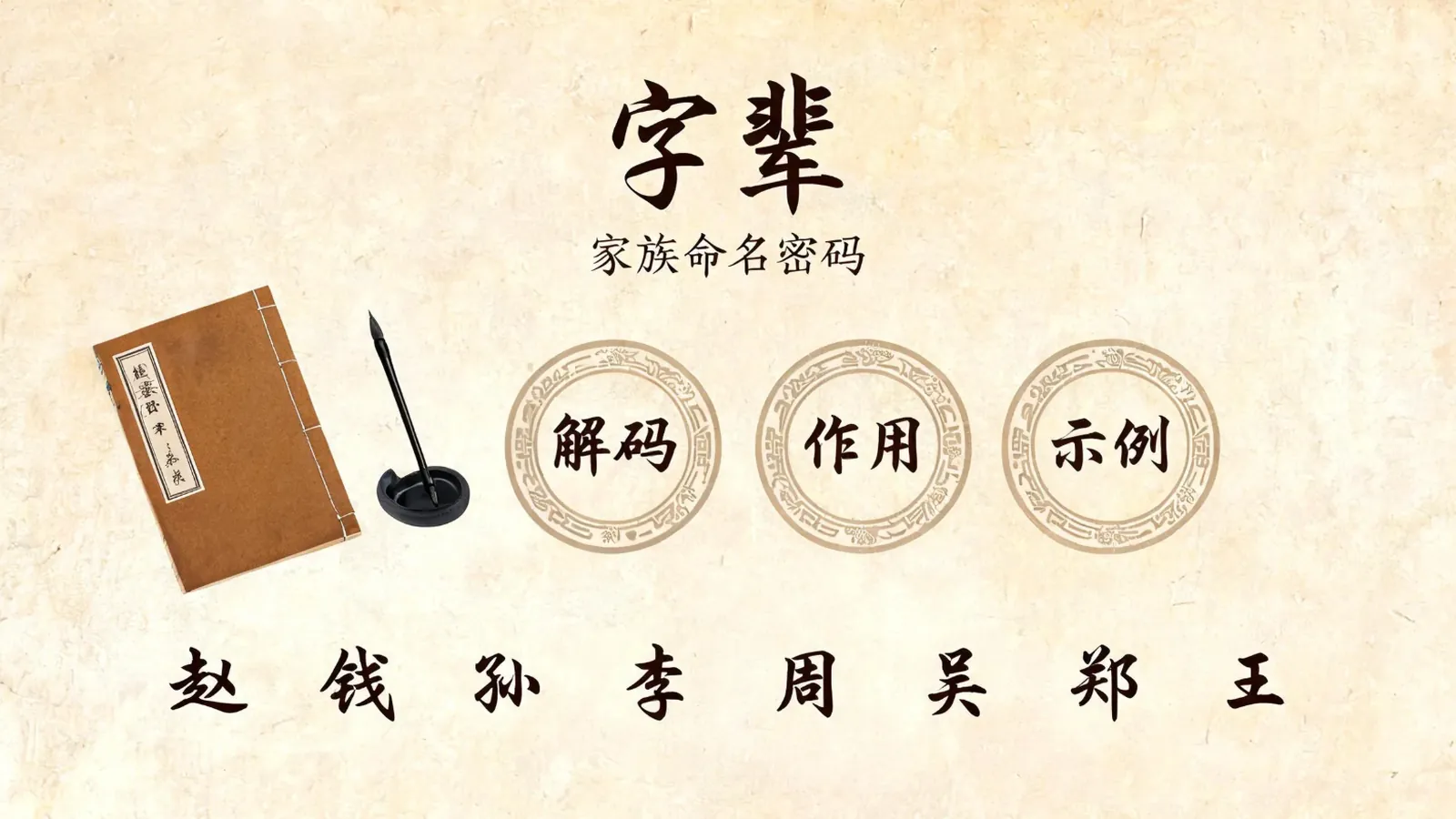
4. Generation Character Examples from 8 Common Surnames
Below are generation character examples for some common surnames (for display only, not complete genealogies):
Zhao Surname (Partial)
| Generation | Character |
|---|---|
| 50th gen | De |
| 51st gen | Chong |
| 52nd gen | Wei |
| 53rd gen | Fan |
Qian Surname (Partial)
| Generation | Character |
|---|---|
| 30th gen | Wen |
| 31st gen | Wu |
| 32nd gen | Zhong |
| 33rd gen | Xiao |
Sun Surname (Partial)
| Generation | Character |
|---|---|
| 60th gen | Zhong |
| 61st gen | Yu |
| 62nd gen | Xiu |
| 63rd gen | Jie |
Li Surname (Partial, Longxi Hall)
| Generation | Character |
|---|---|
| 50th gen | Xiang |
| 51st gen | Guang |
| 52nd gen | Zu |
| 53rd gen | De |
Zhou Surname (Partial)
| Generation | Character |
|---|---|
| 70th gen | Shao |
| 71st gen | Cheng |
| 72nd gen | Xian |
| 73rd gen | Zhi |
Wu Surname (Partial, Zhi De Hall)
| Generation | Character |
|---|---|
| 100th gen | De |
| 101st gen | Shang |
| 102nd gen | Wen |
| 103rd gen | Chong |
Zheng Surname (Partial)
| Generation | Character |
|---|---|
| 40th gen | Shi |
| 41st gen | De |
| 42nd gen | Yan |
| 43rd gen | Xiang |
Wang Surname (Partial, Langya Wang)
| Generation | Character |
|---|---|
| 80th gen | Wei |
| 81st gen | Han |
| 82nd gen | Zhang |
| 83rd gen | Xu |
Note: Each surname has multiple branches (hall names), with different generation characters. Actual queries need to confirm the hall name.
5. Should We Still Use Generation Characters for Naming Today?
This is a question every modern family tree compiling family must answer.
Traditionalist View
| View | Reason |
|---|---|
| Preserve tradition | Generation characters are cultural treasures, lost and irrecoverable |
| Strengthen identity | Generation characters give children natural family belonging |
| Clear ordering | Family gatherings instantly show seniority |
| Instructional meaning | Generation poetry is itself family instruction |
Reformist View
| View | Reason |
|---|---|
| Free naming | Modern people pursue individuality |
| Name duplication | Multiple people of the same generation having the same middle character makes naming difficult |
| Gender equality | Tradition doesn’t distinguish gender, but usage has gender bias |
| Weak practicality | Urbanization reduces clan gatherings, weakening generation character practicality |
My Suggestion: Preserve Generation Characters, But Don’t Force Them
| Situation | Suggestion |
|---|---|
| Family already has generation poetry | Continue using, but allow different names within the same generation |
| Family has no generation poetry | Can compose a new five-character or seven-character generation poem |
| Modern family | Can simplify: use only single-character generations, no poem |
| Cross-national family | Generation poetry can have multilingual annotations |
The essence of generation characters is “generational inheritance” and “family identity” — form can be flexible.
6. Common Questions About Generation Characters
What’s the Difference Between Generation Characters and Seniority?
- Generation characters: specific characters (or poetry), used for naming
- Seniority: generational position (grandfather generation, parent generation, children generation)
Generation characters are tools, seniority is the result.
Who Decides Generation Characters?
Usually decided by family authority or family meeting. Adding new generation poetry requires the whole family’s consent.
Can Generation Poetry Be Modified?
Yes, but with caution. Modifying generation poetry is equivalent to rewriting the family’s cultural genes, with far-reaching impact.
Do Generation Poems Have Copyright?
Traditional generation poetry is in the public domain. Newly composed generation poetry is creative work and can be considered a collective family work.
How to Use Generation Characters for Children of Cross-Surname Marriages?
Modern practice: Take one generation character from each parent’s family, or create an independent new generation character.
Frequently Asked Questions (FAQ)
Q1: How to Look Up My Family’s Generation Characters?
Steps:
- Check old family tree (if any)
- Ask elders (parents, uncles)
- Contact family clan associations
- Check on FamilySearch, Chinese surname platforms, etc.
Q2: What If the Generation Poetry Doesn’t Have Enough Characters?
Two approaches:
- Extend: Write new characters at the end of generation poetry
- Cycle: Restart from the first character (requires family consent)
Q3: Can Women Use Generation Characters?
Modern practice: Yes. Traditional practice tends toward males, but modern family trees encourage equal use of generation characters for both genders.
Q4: Are Generation Characters the Same Across Different Hall Names?
No. The same surname with different hall names (e.g., Li’s Longxi Hall vs. Beihai Hall) has different generation poetry — you need to confirm your own hall name.
Q5: How to Compose New Generation Poetry?
Several principles:
- Good meaning (family instructions, character, expectations)
- Rhyming (five-character or seven-character)
- Sufficient characters (preferably 30-50 characters, used for decades)
- Easy identification (avoid rare characters)
- Family consensus
Example new composition:
Ming De Chuan Jia Yuan, Shi Shu Ji Shi Chang Zhong Hou Cheng Xun Xun, Ren Yi Qi Hou Xiang Qin Jian Li Gen Ben, Qian He Yao Zu Guang
Conclusion
Generation characters are the “micro-genes” of Chinese family culture — using one or two characters, they connect generations of seniority, instruction, and identity.
Today, generation characters have faded in many families. But they remain the wisdom ancestors left us: using the simplest form to achieve the deepest inheritance.
If you’re preparing to compile a family tree, consider composing or extending a generation poem for your family — this may be the most valuable gift you leave to future generations.
A family with generation characters has roots; with roots, it won’t scatter.
Further Reading:
- 📜 Family Trees and Clan Genealogy: A Three-Thousand-Year Cultural Code
- 📚 From Rites of Zhou to the AI Era: The Evolution of Chinese Genealogy
- 💻 Start Making Your Family Tree: Family Tree Design Software
This article was written by Tool Person Zhang Wei. Please cite the original source: https://familytree.design.